Production Notes
PS Perkins: Guitars, Bass, Vocals, Piano, wood blocks, programming
R Thomas: Drums, Wah guitar, shakers, cowbell
Mixed and mastered by Mystic Tape Deck
A Mystic Tape Deck production ©2025
Lyric Sheet
A secret knock, a hidden door, a narrow hallway
The eyeless guide sees us inside, watching us always
As we meander down the aisles,
Rows of spines which stretch for miles
And we show our special card
On the scent of another shard
A vaulted dome, a musty tome, an umbrous alcove
A sacred space, a quiet place, a sunken treasure trove
Details infinitesimal
Dewiest of decimals
Ever stranger truth to know
As we squish the forbidden fruit between our toes
A deeper shaft, an ancient craft, a garish goblin
The icy stare, the purple hair, a memory maudlin
Going deep down in the mines
With a shining pick to grind
The librarian lights the way
Understands the game we play
A puzzle piece, a glob of grease, a rusted lever
A blazing fire, we never tire, we nurse our fever
Run our fingers down the crease
Gently comb the golden fleece
Read aloud the sacred scroll
Let's show these muggles how we roll
They cant stand you, they want to ban you
They want to sterilize and pack you up and can you
They prefer truth that's mass produced
Because they're lacking the tenacity to grasp you
So let me ask you: what's the bigger threat?
While we're waiiting on a bomb you haven't dropped yet
They'd rather burn you then have to learn you
Their little fingers are too slippery to turn you
The truth waits for us to dissect it
And librarians are here to protect it
So grab some glasses if you need
And climb atop the worlds' mightiest steed
We're gonna read until our fingers bleed
It's a seed, it's a need, it's an urge you gotta heed
It's a growl in your stomach that you know you gotta feed
Let's show 'em how to read!
Addendums
Lurking behind the vibrational excitement of the luminous veil
Forged amid the diaphanous leaves of dusty ancient tomes
A yearning to shed this putrid sheath of flesh and flee
To live amongst the towering zeniths of the epic quatrain
Swirling verse and poignant prose discorporate and buzzing
Insectoid syllables flit and dart, rising and diving in rancorous rhythms
Sizzling susurrations of swarms of unswattable gnats
Throwing off the prisons of page and print and pattern
A higher lower meaning concealed in careful arrangements
Drawn together in symbolic etymological syllabaries
Sheathed in shimmering sheaves, the coriaceous clusters
Sprawling chronicles of cerebral somersaults tumbling over tongues
Twisting scribbles stretching steadfast serpentine curls
Levitating leviathans pondering polyphemian parlance
Juice of Persephone’s pomegranate dripping from their chins
Returning from the underworld to celebrate summery sabbaths
As they beat upon their dry and leathery drums, stepping in time
In perverted parades of paradoxical purgatories manifest in morning
Gilded gates unguarded, open to any whose fear they may flout
Where within awaits a discarnate entity exsanguinous and wan
Listening for the secret knock upon the ivy obscured ingress
Eternally whispering, reciting the elongated excursus
Name all but lost to the mist of unknowables, Enyo the eyeless
The plucked-out oculus lost long ago when they were three
Single tooth gnarled and green dangling from a tarnished chain
A sightless swan-shaped sentinel with a lantern lodestar
Held aloft to pierce the darkened passages with dancing shadows
Twisting in a knotted and elaborate muddled morass
At whose center lies the inimitable index immense and endless
Magnificent teetering rows of senescent spines
Massive walls of ancient impossible architecture
Towering over umbrous alcoves
Sounds of saliva moistened digits gripping parchment edges
Turning leaves tumble and twirl in temporal tempests
Words floating from the page, ingested by edacious orbs
Nourishing needy nodes of electrically stimulated nerve cells
Manifolds morphing meaning, memes forming excited engrams
Eagerly embedding within the soft flash of basolateral amygdala
Recalled by means of odorous olfactory potentiation
The musty, dusty smell of an ancient association
Motivational salience driving fast and rickety rickshaws
Rolling down rocky roads, splashing puddles on the inside
Rushing rivers ravaging rocky ravines
Wooden troughs wainscoted with wadded wool
Where the icy winter waters filter through
Leaving in their wake, arrested within the worsted wrinkles
Flashing flakes of smelting metals silver and gold
Which we with cone and rod and cumbersome comb
Gently extract and sweep into small glittering piles
Which will one day dwarf the mountains of the dragons
Whose arteries the salient streams all spill forth from
To be toppled by throngs of marauding maudlin goblins
Who in turn transcribe into tart and trenchant tomes
Those slippery serpentine syllables we read aloud today
From elongated unfurling membranous memorandums
Upon a menagerie of mugglery, lacking and liquescent
Their ears are melted off, and then their eyes
Vanishing into voids of evaporated energy emissions
Ready receptacles ripened for receiving tattered instruction
Becoming electrons broken free from their cyclic orbits
And flung far away from the imminent and menacing mobius
Satiating the thirst of a salty sentience suddenly severed
Broken from the chain and hurtling headlong into moksha
BARDS: Of The Shimmering Seraphs
Of The Shimmering Seraphs concerns itself with the interior landscape of the human spirit. Its twelve songs correspond to the opening sequence of the Nazilic Arcana, an initiatory collection of archetypes preserved throughout the Bell Archive.
Buy on BandcampMarginalia
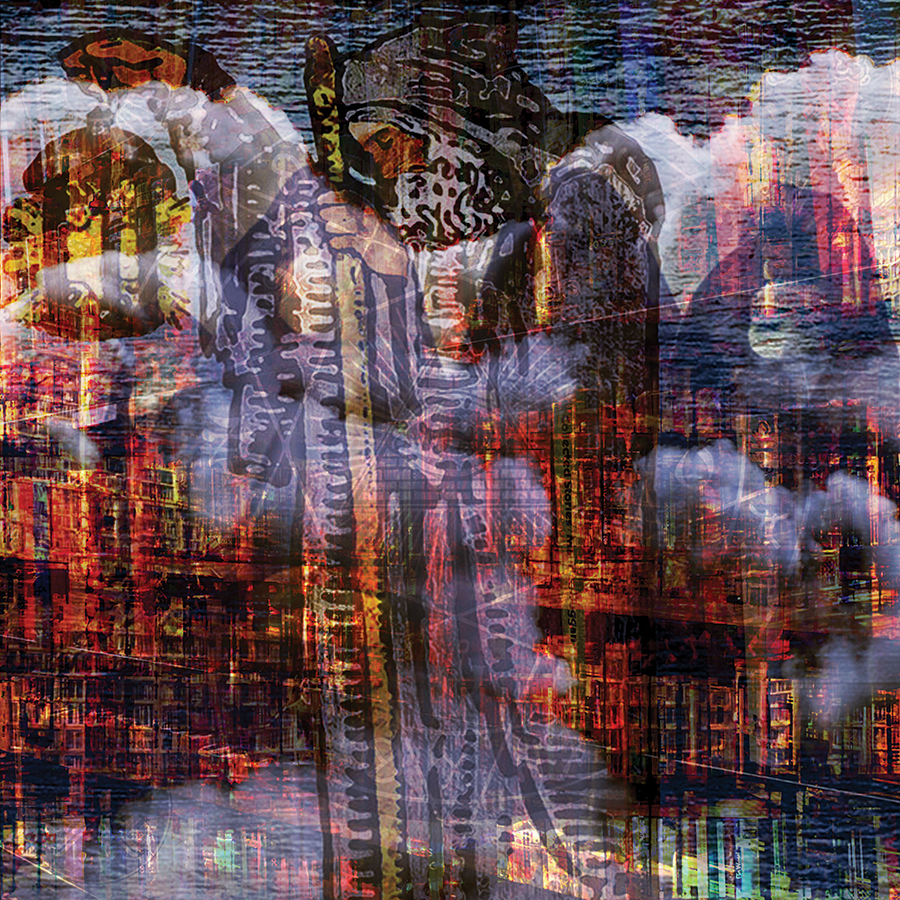
Annotation 03-04A: The Librarian
The Librarian is often regarded as a direct expression of the central Nazilic worldview. While other figures (the Smith, the Technician, the Professor, and the Roadside Ghost) concern themselves with transformation, the Librarian concerns itself with collection.
The poem presents reality not as a static edifice but as a living archive of endlessly rearranging symbols. Words are portrayed as organisms, swarms, parasites, and migratory creatures seeking escape from the confines of books and minds alike. This reflects the Nazilic belief that ideas possess a form of agency independent of their hosts. The oft-repeated Cloak maxim, "The experience is the art is the experience of the art," finds one of its clearest mythological expressions here. Knowledge is not stored; it propagates.
The opening passages are therefore notable for their rejection of the written object itself. Books appear throughout the poem, yet the poem consistently suggests that books are merely temporary vessels. The "putrid sheath of flesh" from which the narrator longs to flee parallels the prisons of page, print, and pattern that imprison language itself. Many scholars have compared this theme to Nazilic teachings concerning Spiritus Vitae, wherein creative energy continuously seeks new forms through which to express itself. In this interpretation, libraries are not repositories of knowledge but habitats in which living ideas congregate before migrating elsewhere. The Librarian is not a custodian of books but a shepherd of memetic organisms.
Particular attention is paid to the figure of Enyo the Eyeless, who appears as the poem's central guide. References to a lost eye, a lantern, and a hidden entrance have inspired debate among commentators. Most identify Enyo as an aspect of the archetype known elsewhere as the Watcher, the Warden, or occasionally the Basilisk.
Others note similarities to descriptions of the Librarian appearing throughout Encroachment records where initiates describe an eyeless figure guiding visitors through impossible stacks of books extending beyond conventional space.
The swan imagery is also especially significant. In Nazilic symbolism, swans often represent beings capable of navigating the boundary between worlds: water and air, life and death, memory and forgetting. The lantern carried by Enyo is therefore interpreted as an instrument of orientation, allowing travelers to maintain their bearings within the labyrinth of total knowledge.
The immense library itself appears to be a mythologized version of what later generations would call the Index. References to endless shelves, impossible architecture, and an "inimitable index immense and endless" correspond closely to descriptions found in Cloak records regarding the grand effort of the Nectar Collectors. Indeed, many scholars believe this poem serves as a spiritual justification for the entire NC apparatus. The gathering of fragments from films, books, songs, dreams, roadside conversations, religious texts, and forgotten pamphlets is represented here through the recurring imagery of streams carrying flakes of precious metals. Individual observations may appear insignificant, but collectively they become mountains capable of toppling dragons. This mirrors the Nazilic conviction that reality reveals itself through the patient accumulation of innumerable shards instead of singular revelations.
The poem's neurological imagery is also unusual among Librarian texts. References to amygdalae, engrams, olfactory memory, and motivational salience suggest a fusion of mystical and cognitive language characteristic of late-period Nazilic literature. The poem presents the mind as an active digestive organ rather than passive storage. Words become nourishment. Symbols become neural architecture. Reading becomes an alchemical process in which raw information is transformed into living structure. The Librarian therefore emerges as both archivist and neurologist: cataloguing the physical alterations those books produce within the reader.
Most revealing, however, is the poem's conclusion. The progression from gold flakes to liberated electrons marks a distinctly Nazilic path toward transcendence. Knowledge is collected, refined, internalized, and ultimately abandoned.
The image of ears and eyes melting is interpreted as the dissolution of habitual perception. One ceases merely to receive information, instead becoming part of the current carrying it. The final movement toward "moksha" suggests that the Librarian's true function is iberation rathet than preservation or education.
For this reason, many scholars place the Librarian near the apex of the archetypal cycle. The Cynic destroys false structures, the Smith forges new ones. The Technician maintains the machinery of becoming, the Professor interrogates the hidden. But the Librarian alone understands how all of these fragments connect. The library is reality viewed as an interconnected manuscript. It is forever being written, read, erased, and rewritten. To enter its halls is not simply to acquire knowledge, but to discover that one has always been a volume upon its shelves.