Production Notes
All drums and percussion: R Thomas
Guitars, synths, scraping sounds, vocals, bass, lyre, slide lyre, lyrics: PS Perkins
Mix and master by Mystic Tape Deck
A Mystic Tape Deck production ©2025
Lyric Sheet
E'en that...
Who'll supply the shovels used to split the sacred soil?
And who will help the spirit shuffle off this mortal coil?
Who'll embalm the body, who will mummify the husk?
And who will sail the flaming ship into the drowning dusk?
And who will dig the grave digger's grave?
Who will dig the grave diggers grave?
Who will dig the grave diggers grave?
Who will bury them?
Who is going to drive the hearse and consecrate the wine?
Who is going to build the box from the gnarled and knotty pine?
Who will be the artifex to decorate the tomb?
And who will bribe the jackal waiting at the gates of doom?
And who will dig the grave digger's grave?
Who will dig the grave diggers grave?
Who will dig the grave diggers grave?
Who will bury them?
E'en that...
"In youth, when I did love, did love,
Methought it was very sweet,
To contract, O, the time, for, ah, my behove,
O, methought, there was nothing meet."*
But age, with it's stealing steps
Hath clawed me in it's clutches
Age, with its stealing steps.
E'en that...
*From Shakespeare's Hamlet Act 5
Addendums
Pulling on the mud caked creased and drawn leather boots
Feet cold, atonic and rheumatic, bunions bulging, inflamed
Shabby woolen blanket tossed aside in a crumpled mass
The sun has not yet risen, the day begins without a shadow
No beaks of birds commanding chirrups of lilting or alarm
A stifling stillness as the waking world trembles, warming
Puffs of pungent briny breath passing between nidorous cuspids
Dissipating gloom drifting into a moodless morning chill
Dragging footsteps scraping seas of dew drenched blades
Where beneath the sagging sapling, a sack sits silent
As the shoveling sounds of splitting earth fall in loose rhythms
Elbows creak, hips pop and swivel, knees crackling raw and crass
Thudding soil falls and tumbles, amassing morbid mounds
Worms wriggle and writhe, tight air stinging slimy skins
Earthen apertures and widening orifices inaugurate the carcass
Linger to be lowered while the grim and grievous bow
And wistfully weep into stained white silken handkerchiefs
But to the striking sharpened spade they mean nothing
A parcel entombed in a pine box knotted and gnarled
Inhumed into the cavernous maw, dressed and darkened
Draped atop the kindled pyre and set aflame by arrow
Disappearing into darkly sparkling cold and choppy seas
Burned to ash and drifting into star spotted skies
Lifted high and flung across cottage dotted country sides
Body tossed shamelessly over top of collapsing city walls
Picked apart by carrion creatures tugging sinewy straps
Beyond gates guarded by dripping jaws of jewel eyed jackals
For the gallows does well to those who would do ill
Never a shortage of cadavers delivered down the hill
On wobbly wheeled canvas carts of jostling limbs and torsos
Over bumps and rutted roads, skulls split and tumbling
Halting against the boots of the lunching laborer
A pointed pause to snatch a snort of stinging sour liquor
Chewing sounds and smacking lips, clumps of soft bread
Packed against incisor gaps and washed over with saliva
As once again the dull pointed pickaxe splits the soil
Busy days of dying death make for dreary days of digging
Going all, where all must go unquestioning, irresistible
As age with its stealing steps claws us in its cold clutches
And the great wheel creaks and moans as it turns again
The fortune has been sold, the future told and set precedes you
Ineludible fate, a steady ripple across a turbid temporal tarn
Advancing unwilling faraway and mucky mist laden shores
Unfamiliar croaks of murky mysterious and glistening amphibians
Clouded retinas glowing, rustling just beyond the ring of reeds
Cloistered in shadows deep and moist amidst tangled roots
Reaching tendrils claw and creep through sand specked mud
Slimy fungus crouching in the hollows of a whispering withered log
Robed in ripened mucous membranes thick and gooey mosses
Revolting miry algae clumped in steaming heaps buzzing with insects
Stench of bubbling gases gurgling through grimey gummous ooze
Squeezed through stinking jellied gills of putrid piscine parcels
All are bound unknowing to the ever-repeating mobius
Ceaseless cyclopean cycles, cascading currents cleaving canyons
Wherein walks the grave digger, bearing artifacts of the Artifex
Mummified masterminds shambling subterranean stone corridors
Angular arcs of sunlight stabbing motes of dusty ancient air
A solemn somnolent sexton dangling ugly unwashed toes
Taking their repast and farting bluntly as they contemplate
Whom shall be next to pick up the spade and shoulder the station
Of they who embalm and entomb the stiffened lifeless husks
When into the trough they tumble themselves
Upon their drowning dusk
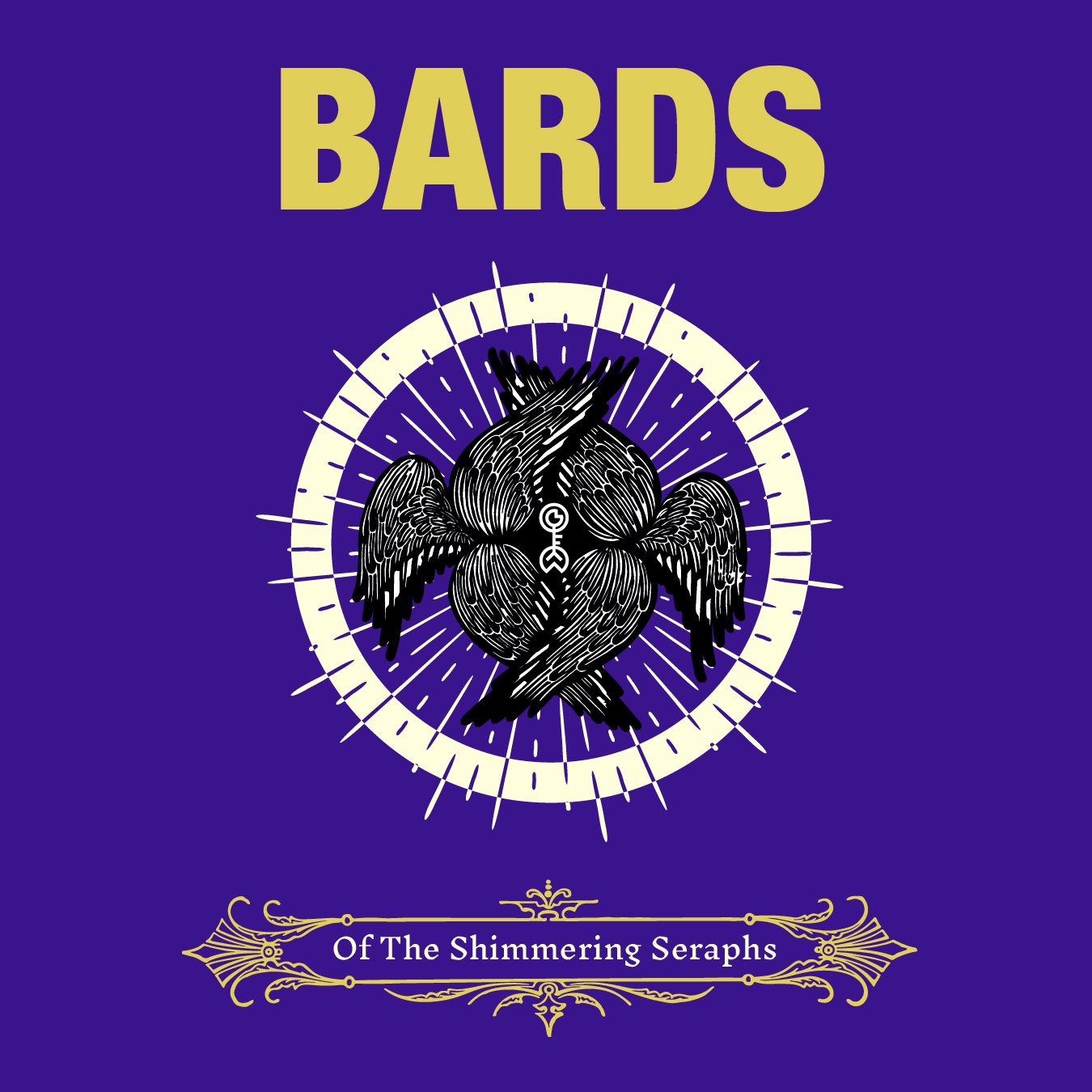
BARDS: Of The Shimmering Seraphs
Of The Shimmering Seraphs concerns itself with the interior landscape of the human spirit. Its twelve songs correspond to the opening sequence of the Nazilic Arcana, an initiatory collection of archetypes preserved throughout the Bell Archive.
Buy on BandcampMarginalia
Annotation 03-09A: The Grave Digger
Among the archetypal cycle, The Grave Digger is generally understood as the custodian of transition. Whereas the Smith concerns beginnings and the Librarian concerns preservation, the Grave Digger concerns dissolution and return. Notably, the poem demonstrates little interest in any single funerary practice, instead presenting burial, cremation, exposure, sea burial, and execution as equivalent destinations within a larger process. Nazilic scholars have long cited this as evidence that the poem's true subject is not death itself but the mechanisms by which societies metabolize death. The Grave Digger appears not as a mourner but as a laborer tasked with maintaining the continuity of the cycle.
Particular attention has been given to the poem's fixation upon repetition. Wheels turn, rivers flow, amphibians lurk in recurring marshes, and all things are described as being bound to an "ever-repeating Möbius." This imagery has led many commentators to associate the Grave Digger with the doctrine of Eternal Recurrence found throughout Nazilic literature. The laborer's work never concludes because existence itself never concludes. Corpses become soil. Soil nourishes roots. Roots nourish life. Life returns once more to the spade. The Grave Digger therefore occupies a peculiar position within the cosmology: he is simultaneously servant of the cycle and prisoner of it.
The appearance of the "artifacts of the Artifex" has generated substantial scholarly debate. Some interpret the phrase as a reference to relics recovered from previous iterations of reality, while others connect it to the hidden technologies associated with the Technician and the subterranean manufactories of the Shining One. In either case, the Grave Digger is portrayed as a figure who regularly encounters the remnants of forgotten worlds. Unlike historians or librarians, however, he does not preserve them. His role is merely to carry them forward until they too pass beneath the earth.
Most significant is the poem's concluding paradox. Having spent a lifetime interring the dead, the Grave Digger eventually confronts the necessity of his own burial. Nazilic philosophers frequently cite this passage alongside the ancient riddle of the barber who shaves all men who do not shave themselves. Such self-referential contradictions are regarded within the Cloak as "causal singularities"—locations where ordinary logic begins to fold back upon itself and reveal deeper structures beneath. The Grave Digger's dilemma is therefore viewed not as a problem to be solved but as a doorway through which understanding may enter.
Some later commentators have gone further still, arguing that the Grave Digger is not a person at all but a personification of causality itself. In this interpretation, every ending requires a force that carries it forward, yet that force must eventually become subject to its own operation. The final image of the Grave Digger tumbling into the trough upon his "drowning dusk" thus mirrors the fate of the Shining One, the Technician, and even entire civilizations. No mechanism stands outside the wheel. No custodian escapes custodianship.
For this reason the Grave Digger is often regarded as one of the most unsettling figures in the archetypal cycle. The Cynic dismantles illusions. The Smith offers creation. The Librarian promises meaning. The Grave Digger offers neither comfort nor escape. Instead he presents a single unavoidable truth: every system eventually processes itself. The hand holding the spade is already standing at the edge of its own grave. And somewhere beyond the final shovelful of earth, another hand is reaching for the handle.