Production Notes
Guitars, Bass, iPhone, programming, samples, vocals: PS Perkins
All drums and percussion: R Thomas
Lyric Sheet
Here inside the factory
The sentient machinery
Consider actuality
Superfluous analogy
There are many kind of meat
There meat to wear, and meat to eat
But here they make a special meat
To animate anatomy
What shall be it’s true dominion?
Still a matter of opinion
Cords and wires and tubes and gaskets
Never taking any chances
Carefully select components
Following the master blueprints
Imbue them with morality
With which to sculpt reality
The highest cardinality
A gift for the perfunctory
What shall be it’s true dominion?
Still a matter of opinion
Ever since it’s first inception
Battling it’s own reflection
Practiced well in self deception
Questioning it’s own perception
There is only one exception
One who might achieve perfection
Deep inside we hide the prize
And shield the light behind it’s eyes
What shall be it’s true dominion?
Still a matter of opinion
Addendums
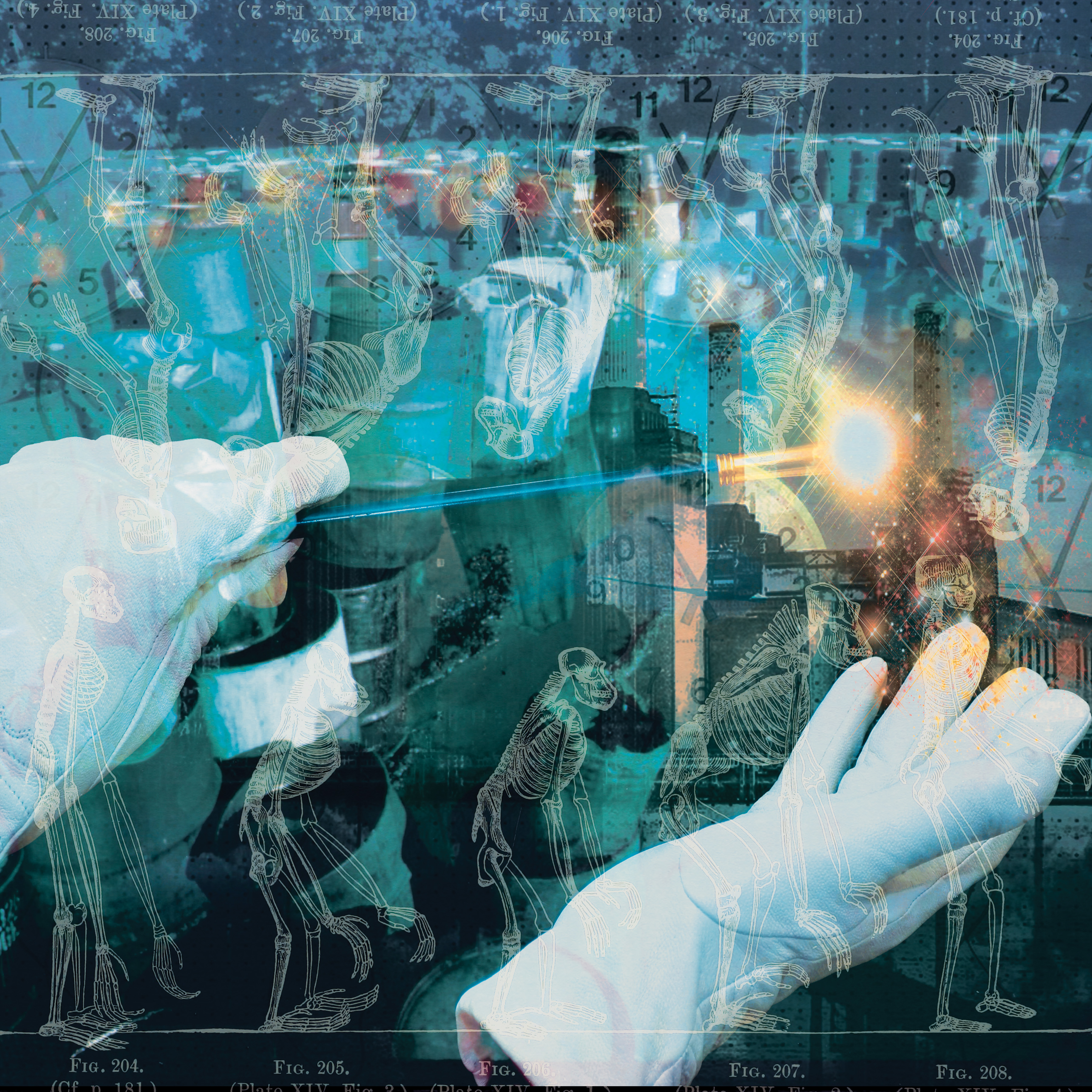
The pseudo mechanical creators inside the factory where humans are assembled and genetic materials are printed from the codex delivered in the fallen capsule.
BARDS: Of The Next Revolution
The second vessel in the BARDS series follows humanity's gradual rediscovery of memory, creativity, and purpose after yet another civilizational collapse.
Buy on BandcampMarginalia
Annotation 02-04-A: The Factory Beneath the Mountain
The "factory" described throughout the fragment is generally identified with the subterranean Manufactories referenced elsewhere in the Smith Cycle. Contrary to popular interpretation, however, the Builders are rarely portrayed as infallible architects. Surviving Bell manuscripts consistently emphasize their meticulous craftsmanship while remaining conspicuously silent regarding their certainty. Components are measured, assembled, and tested according to inherited designs, yet the repeated refrain—"What shall be its true dominion? Still a matter of opinion."—suggests that even the Makers remain uncertain what humanity is ultimately intended to become. Several scholars have therefore argued that creation itself is presented not as the execution of a perfect design, but as an ongoing act of experimentation.
Annotation 02-04B: On the Special Meat
The phrase "a special meat to animate anatomy" has generated considerable commentary owing to its deliberately reductionist language. While the expression appears almost irreverent, most Nazilic authorities regard it as an intentional reminder that biological substance alone possesses no intrinsic sanctity. Flesh is described as material awaiting animation rather than life itself. Bell Family archivist Nathaniel Bell observed that throughout the surviving corpus, bodies are consistently treated as vessels, instruments, or garments rather than identities. One marginal annotation reads:
"Clay is not diminished because the potter hopes for music."
Annotation 02-04C: The Master Blueprints
References to "master blueprints" have frequently been compared with the Codex traditions surrounding the Fallen Capsule. According to these accounts, the Builders possess an inherited archive from which successive generations of humanity are reconstructed following each Revolution. Curiously, no surviving manuscript claims that the Codex contains complete instructions. Instead, numerous fragments imply that each iteration requires interpretation. The Builders therefore function less as manufacturers than as artisans, continually resolving ambiguities left unresolved by those who designed the original plans. This distinction has been cited as evidence that creativity itself occupies a necessary place within an otherwise deterministic universe.
Annotation 02-04D: Imbuing Morality
The instruction to "imbue them with morality, with which to sculpt reality" is regarded as one of the earliest surviving statements of the Nazilic belief that ethical behavior is not merely social convention but an instrument capable of altering causality. Under the Doctrine of Reflection, every action contributes recursively to the conditions from which future civilizations emerge. Morality is therefore understood less as obedience than as architecture. One builds tomorrow by choosing today. Bell Archive Note M-8 summarizes the principle succinctly:
"Character is simply engineering performed across generations."
Annotation 02-04E: Battling Its Own Reflection
The latter portion of the fragment shifts from manufacture to introspection, describing humanity as perpetually "battling its own reflection." Phenominomic scholars have interpreted this as an allusion to consciousness itself. Having been endowed with self-awareness, humanity becomes both observer and observed, designer and designed. The conflict is therefore not between humanity and its creators, but between successive versions of itself. Every civilization inherits the unfinished work of its predecessors while simultaneously attempting to escape them. The Mirror traditions preserved elsewhere in the Bell Collection are frequently cited in connection with this passage.
Annotation 02-04F: The Hidden Prize
The concluding image—
"Deep inside we hide the prize, and shield the light behind its eyes."
—has produced one of the longest-running disputes within the Department of Esoteric Anthropology. Orthodox interpreters identify the "prize" with the dormant potential of the Shining One present within every human being. Others argue that the passage refers instead to consciousness itself, concealed from external observation and therefore inaccessible to direct study. A minority position proposes that the Builders intentionally obscure the true purpose of humanity even from humanity itself, believing that certain forms of understanding cannot be implanted but must emerge spontaneously through lived experience. Bell Fragment C-91 offers only the following remark:
"The treasure is hidden not to protect it from thieves, but from architects."
Annotation 02-04G: On the Importance of Creation
Although the title initially appears almost humorous in its simplicity, later Bell scholars increasingly regarded it as one of the most profound statements in the BARDS collection. The importance of creation lies not in the production of objects, but in the transformation of the creator. Throughout Nazilic literature, every act of making is simultaneously an act of self-construction. The Builders assemble humanity; humanity constructs civilization; civilization, in turn, recreates the Builders. The Cycle therefore advances through reciprocal acts of creation in which maker and made continually exchange places. One unsigned Bell memorandum concludes:
"The workshop was never intended to manufacture people.
It was built so that people might eventually learn how to manufacture themselves."