Production Notes
Rhythm guitars, Bass, programming, vocals : PS Perkins
All drums and percussion: R Thomas
Guitar solo: K Finch
Lyric Sheet
When we were hungry they cut off our bread
And loosed the infection to study its spread
You know that the poison is all in your head
But justice is measured in violence instead
And if you complain, they just tighten the chain
Safe in their castles, immune to our plight
We gather in numbers, prepared for a fight
With shovels and axes we move through the night
Sneaking in shadows of gallows in fright
And we hold on to hope as they tighten the rope
And we fight them!
Nothing to lose, fight them!
What would you choose tonight?
It’s all coming down to the wire
Peace is our only desire
Freedom is what we require
So we’re holding their feet to the fire
Slowly but surely, their torture begins
Invisible leeches at work on our skin
Knowing this battle is not one we win
Still we rise and we fight them again and again
Cut to the bone, we are all out of stones
Still we fight them!
Nothing to lose, fight them!
What would you choose tonight?
It’s all coming down to the wire
Peace is our only desire
Freedom is what we require
So we’re holding their feet to the fire
Addendums
Humanity has a strong will to fight when it comes to survival. Is it strong enough to survive the fight inside ourselves? If we can believe we are more, we can fight beyond our last stone.
The revolution isn't ultimately against governments, pandemics, or institutions. Those are manifestations. The true revolution is against the recurring human impulse to surrender to cynicism, fear, and deterministic despair. That's a revolution worthy of the Shining One's long struggle.

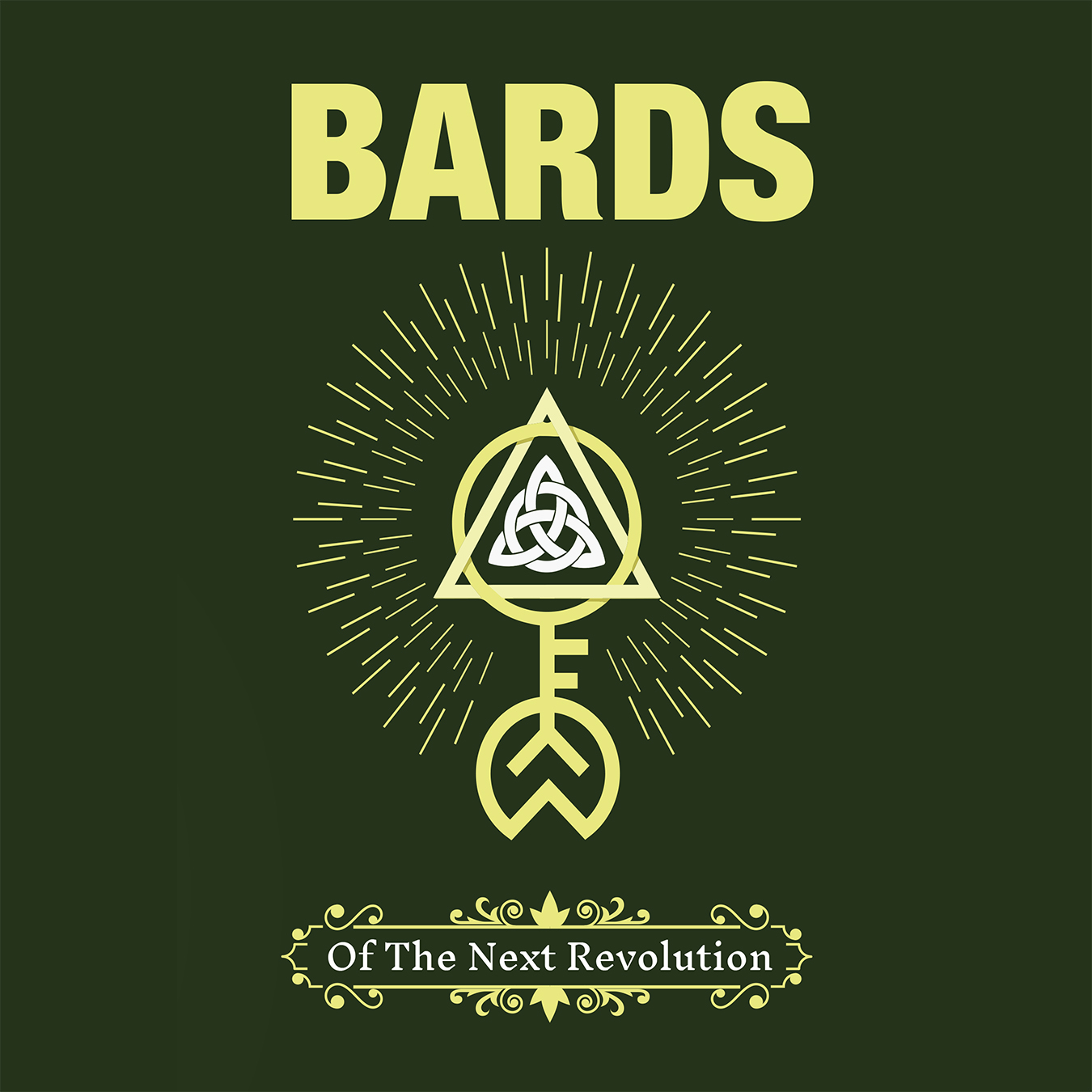
BARDS: Of The Next Revolution
The second vessel in the BARDS series follows humanity's gradual rediscovery of memory, creativity, and purpose after yet another civilizational collapse.
Buy on BandcampMarginalia
Annotation 02-09A: The Next Revolution
Although the title has often been interpreted as anticipating political upheaval, most Nazilic commentators insist that the word "revolution" is intentionally multivalent. Throughout Bell literature the term simultaneously denotes insurrection, celestial orbit, mechanical rotation, and recursive return. The fragment therefore asks whether humanity's next revolution will merely repeat the last, or whether the turning itself may finally become transformative. Bell Archive Fragment R-8 observes:
"Every wheel revolves.
Very few become new."
Annotation 02-09B: The Enemy Within
Early readers frequently identified the unnamed antagonists as kings, governments, merchants, or occupying powers. Later scholarship generally rejects any singular interpretation. According to the Doctrine of Reflection, oppressive systems inevitably manifest externally only after first becoming internal habits of fear, certainty, and domination. Thus the repeated injunction to "fight them" has traditionally been understood as referring simultaneously to outward injustice and inward corruption. One Bell lecturer remarked:
"The tyrant outside survives only because the tyrant inside continues voting."
Annotation 02-09C: The Last Stone
The lyric's closing image—
"Cut to the bone, we are all out of stones."
—has become one of the most frequently cited expressions of late Nazilic ethics. Rather than celebrating victory through overwhelming force, the fragment locates dignity precisely at the moment when violence ceases to offer meaningful solutions. Having exhausted every weapon, the only remaining act is perseverance itself. This interpretation accords closely with numerous Bell texts describing compassion as the final form of courage available to an exhausted civilization.
Annotation 02-09D: Peace as Insurrection
Perhaps the fragment's greatest paradox lies in its repeated declaration:
"Peace is our only desire."
The surrounding imagery invokes axes, shovels, gallows, ropes, infection, castles, and rebellion, yet the stated objective remains neither conquest nor vengeance but peace. Nazilic scholars have long argued that this inversion distinguishes the song from conventional revolutionary literature. Violence is presented not as aspiration but as evidence of profound civilizational failure. The true revolution, according to several surviving Bell commentaries, is the creation of conditions under which violence is no longer required.
Annotation 02-09E: Holding Their Feet to the Fire
The recurring expression has generated considerable discussion within Bell scholarship. While superficially suggesting retribution, many commentators instead interpret the fire as symbolic of refinement rather than punishment. Throughout Nazilic literature furnaces, crucibles, and forge fires consistently represent transformation through ordeal. Thus even the fragment's adversaries are not condemned as irredeemable enemies, but as participants in the same unfinished process of human becoming. Bell Family philosopher Margaret Bell summarized the principle succinctly:
"Justice worthy of tomorrow reforms what revenge would merely replace."
Annotation 02-09F: Hope Beyond the Wire
Among later Encroachments, this composition became associated with what came to be called The Doctrine of the Last Stone—the conviction that hope acquires its greatest significance only after ordinary strategies have failed. The song repeatedly returns to images of tightening chains, ropes, scarcity, and exhaustion, yet never relinquishes the belief that humanity remains capable of choosing differently. For this reason the fragment is frequently performed alongside We Are More, the two works together expressing what many scholars regard as complementary Nazilic propositions: first, that humanity possesses the capacity for transformation; second, that such transformation is tested only under conditions in which despair appears entirely justified.