Production Notes
Guitars, bass guitar, programming, samples, vocals: PS Perkins
All drums and percussion, keyboards: R Thomas
Lyric Sheet
Wandering around in the wilderness,
Wondering when I’d fall off the edge
Watching as the goat slips and trips over the ledge
Besides the bloody bones, there was nothing that remained
Oh…landing on a landslide, insects, we slip and slide
Wondering around in the land of the lost,
Watching as the highlander Searches in vain,
With a subtle psycho-pathetic black candor
He seemed to have lost something at great cost
So he slaughtered a lamb
And cutting up the cadaver,
He took a shower in the falls
Wandering around in the wilderness,
Through the eyes of a necromancer
As he digs up the remains of a long-passed ancestor
Skull, spine and hips, thigh bones and ribs
were all that remained
Landing on a landslide, like insects we slip and slide
He crushed up the bones
And mixed them with the soil left of the flesh
And with his blood, and that of the lamb
And of the mountain goat
He was flying full of fire, spitting sparks, ever higher
Spinning on the threshold of the heavenly desire
As he gazes out over the grasses
The stars form a picture,
his light begins to flicker
As he soars up over the tower
Poles, charged with power
And sparks like stars in showers
He moves inside you, hunting you down
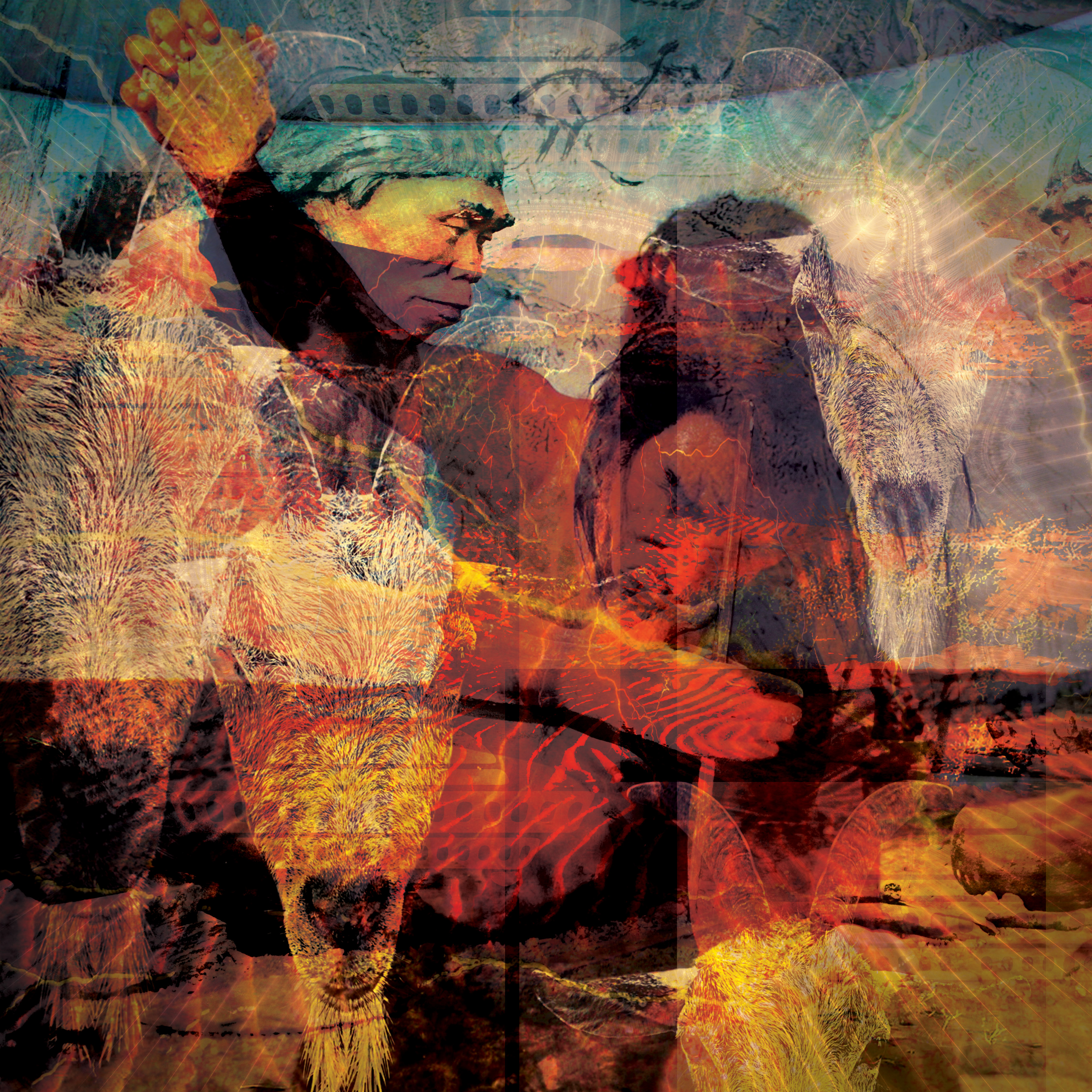

BARDS: Of The Morning Star
Of The Morning Star is generally regarded as the foundational musical text of the Nazilic tradition. More than a collection of songs, it presents a complete cosmology in thirteen movements
Buy on BandcampMarginalia
Annotation 01-03A: Necromancy as Archaeology
Although frequently catalogued among the darker fragments of the First Collection, later Bell scholars have consistently argued that the poem concerns neither death nor sorcery in any conventional sense. Within Nazilic doctrine, necromancy is rarely understood as communication with the deceased. Rather, it describes the deliberate recovery of memories still embedded within matter itself. Bones, blood, soil, and ash are treated throughout the Archive as repositories of causal residue rather than supernatural objects. The necromancer therefore excavates not spirits, but histories.
Annotation 01-03B: The Seat of the Soul
The accompanying notes identify the fragment as part of the Shining One's search for the "seat of the soul," a phrase whose meaning has remained controversial. Some commentators have proposed that the search concerns a literal anatomical structure. Others maintain that the poem ultimately rejects this possibility altogether. Throughout the fragment the seeker repeatedly destroys, disassembles, and recombines bodies, yet nowhere discovers the object being sought.
Bell philosopher Ruth Ashcombe concluded that this absence is itself the lesson: "He searched every bone except causality."
Annotation 01-03C: The Threshold
The repeated imagery of falling, slipping, ledges, landslides, and thresholds has prompted comparison with numerous later Bell Path traditions. Scholars have noted that the fragment never portrays enlightenment as ascent alone. Every elevation is preceded by collapse. The mountain goat's fall, the disturbed graves, and the pulverized bones all function as transitional states in which older forms must first lose their integrity before new understanding becomes possible. This paradox would later become central to the Doctrine of Recursive Refinement, wherein apparent destruction frequently conceals deeper integration.
Annotation 01-03D: The Bones Remember
The final verses have attracted sustained attention for their unusual transition from physical ritual to cosmic imagery. Bone dust gives way to stars; blood becomes electricity; towers become conductors; and finally the unnamed presence begins moving "inside" the observer. Bell commentators generally interpret this progression as marking the moment the Shining One abandons the search for the soul as an object and instead begins recognizing consciousness as a distributed phenomenon woven throughout the entire fabric of existence. Later Library texts repeatedly return to this idea in the language of Spiritus Vitae, recursive memory, and the Doctrine of Reflection.
A marginal annotation recovered from Bell Archive Fragment H-12 simply reads:
"The dead never answered him.
The universe did."
Annotation 01-03E: Before the Professor
Modern readers frequently compare this fragment with the later Professor cycle, in which necromancy becomes significantly more sophisticated and philosophically developed. Bell historians generally regard Rubbing (The Pain) as an earlier stage in that evolution. Here the practitioner still believes the answers lie hidden within graves and relics. The Professor fragments, by contrast, increasingly suggest that memory resides not within corpses themselves but within the larger architecture of causality surrounding them. For this reason, some scholars have described the present work as the apprenticeship of the Professor, composed before the discipline of Nazilic necromancy had fully separated itself from ordinary ideas of death magic.