Production Notes
Drums, percussion, mixing: R Thomas
Guitars, Melodica, Bass, Vocal, MIDI, mixing: PS Perkins
Mixed and mastered by Mystic Tape Deck
A Mystic Tape Deck production ©2025
Lyric Sheet
Adrift In a world that you can't comprehend
As you shuffle down sidewalks you used to defend
And pick through the garbage from parties you no longer attend
You know you're a stranger in still stranger lands
Where the crumbling monuments once used to stand
And they look at you funny when you ask them where to find an honest man
When you're gone, long, long gone
When they try to dismiss you, you piss on their shoes
As they fondle their falsehoods and call them the truth
If only the hunger in our bellies were so easily soothed
But you are not like them and you don't even try
No matter how rotten, you can't make them cry
You're as real as their shadows but they'll never understand why
Until you're gone, long, long gone
So you eat in the market and sleep in a hole
You drink from your hands now instead of a bowl
Stand naked before them to show how the years take their toll
And when the wild dogs come to nip at your legs
And the passing onlookers who expect you to beg
But your life was a promise and it's far too late now to renege
And then you're gone, long, long gone
Addendums
Upon the day of passing, the family gather to prepare the vessel.
There would be time to mourn, but that time was not now.
First one must wash the body, and tie the toes,
Mark the forehead, and sheathe the body in a white robe.
The pyre was built near the river; the family would carry the lifeless body there.
“Let your eye go to the sun, your life-breath to the wind. Go to heaven and to earth as is fitting.
Or go to the waters, if it has been fixed for you there. Take your stand in the plants with your limbs.”
The drifting ashes make them all unclean so they wash themselves.
On the twelfth day they feed the poor who gather on the street in their knowing expectation.
To reach the verdant pastures, the shepherd must cross the charnel ground.
The charred remains lie draped over the fixed ashes of their dwindling pyres,
Motionless husks lie still and discarded in heaps while insects buzz and burrow.
The Aghori sit in motionless meditation atop the bloating corpses.
Sipping water through the holes in the skulls, they rub their naked bodies with the ash.
They defecate upon the ground and pick from soft bits of flesh to eat.
Their renunciation is manifest in their eremitism.
The shepherd leads the sheep along the winding rutted path.
Their gentle bleating falls hollow amongst the cushions of corpses.
Nooses numbering eight tether them tightly ‘round their fattened necks.
The cynic emerges from their shaded ceramic jar and stretches in the sun.
Then it is to the market to find a discarded apple or scrap of meat.
In this particular scenario, it helps to follow the dogs.
They wind and scamper deftly under trampling foot, following their nose.
The cynic takes their repast beneath the weighted gaze of those considered civilized
Decidedly cosmopolitan, clothed only in a tattered robe once white now soiled with age.
Things are those which accumulate among that for which cynic has no need.
Long ago slain were the hydra, the lion, the birds, the boar, and the many headed giant.
The cynic emerging from the underworld with the three headed dog, only now unleashed.
The father of the minotaur hoisted upon gristly shoulders, holding aloft the heavens.
Crudely defacing the coin, the cynic wanders the street, lantern in grasp.
The wild dogs cower and nip at the legs as the cynic drifts into the cave, searching.
Stone simulacra stand erect and motionless save for the erosion of time.
(From dust they come and to dust they go, as from whence they came by the artists’ deft chiseling)
Their shadows cavorting upon the wall are a menace the cynic, who wonders
Perhaps a hero, fearless and free from death, is to be found lurking among their umbrous murk.
Freed of mindlessness, folly and conceit, the cynic finds themselves in accordance with the world.
With no use for dancing shadows upon the wall, in perpetuity superseding mere modesty.
Kneeling to scoop water from the stream to drink from their hands, it is there the cynic finds the honest man.
Opposing forces lie at the extremes of the wave, as colors set furthest apart on the rainbow
But extremes are illusory, as are its sets of opposites, merely aspects of the oneness of each
As the right hand is not accordingly opposite the left, as death is not opposite birth
The passage of time marked by the journey across the chopped and restless sea
The true technicians observe this connection, that the pond ripples are a kind of stillness
As though what we experience is experiencing us, the shape makers, the observers
An innermost eye well fixed upon the moving stream can bring it to steadiness
The spinning top appears to spin in reverse or stand motionless upon its point
A single star in constellation, a ray of light eternally stretching across the vast cosmos
Frozen in motion, staring stoic statues entropic forces wearing marble to sand,
Casting their menacing shadows upon the cave walls, in a theatre for the damned
Collapsing in concert, the moment the petal drops from the flower, the audience gasps in delight
Awestruck by the beauty of the cosmos, always in motion, all perfectly still.
All are entwined and compressed into oneness, expanding into a formless eternity!
Nothing ever disappears, merely changed as they circle their fading pyres in prayer
And pitch their tuning forks upon the heaps of withering bones and wilting flesh
The drifting ashes make them unclean, so they wash themselves
The shepherd is unaware, though it makes no difference, as the prisons are all empty now.
Only the echoes continue, they remain unscathed and ultimately unashamed.
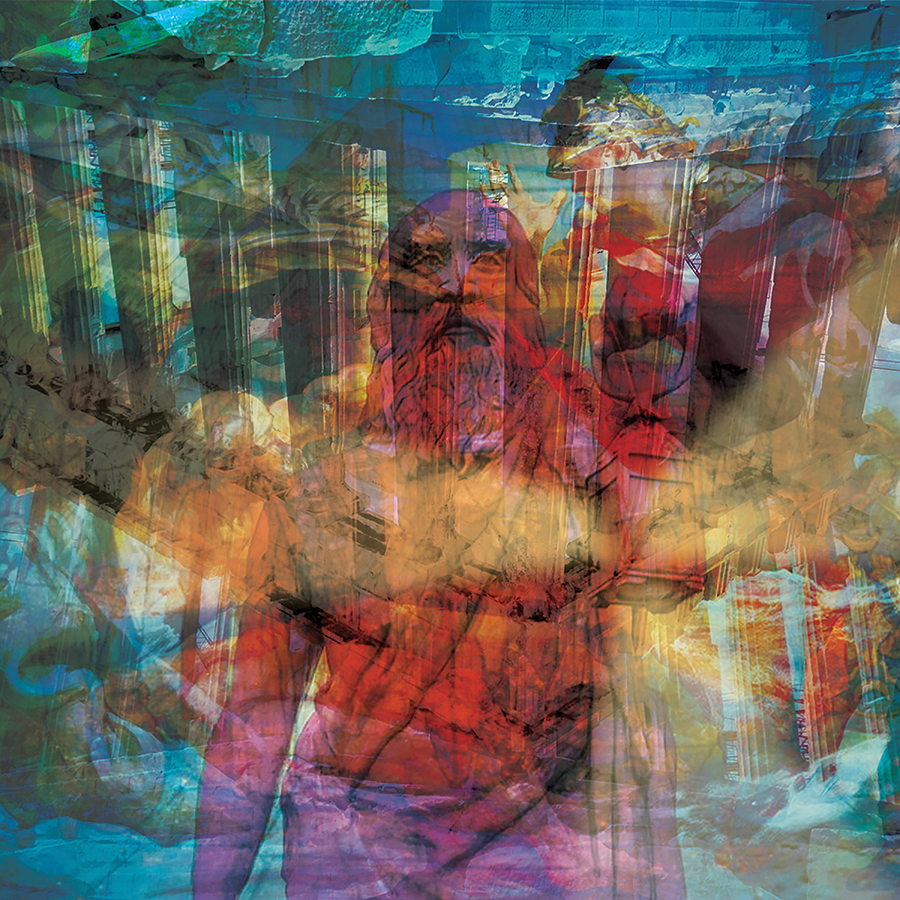
BARDS: Of The Shimmering Seraphs
Of The Shimmering Seraphs concerns itself with the interior landscape of the human spirit. Its twelve songs correspond to the opening sequence of the Nazilic Arcana, an initiatory collection of archetypes preserved throughout the Bell Archive.
Buy on BandcampMarginalia
Annotation 03-00A: The Cynic
Nazilic scholars generally regard The Cynic as the first movement in a larger initiatory cycle, corresponding to the state of radical unmaking which precedes transformation. Although many readers immediately recognize references to historical Cynic philosophers—particularly Diogenes of Sinope and his lantern-bearing search for an honest man—the poem deliberately conflates Greek Cynicism with a broader collection of funerary, ascetic, and mystical traditions. The opening funeral rites, the Aghori seated among cremation grounds, the shepherd crossing fields of corpses, and the Cynic emerging from a ceramic vessel all point toward a singular Nazilic theme: wisdom begins not with acquisition, but with relinquishment. The repeated presence of death serves less as a morbid fixation than as a solvent intended to dissolve illusion, vanity, and attachment. The Cynic is therefore understood not as a pessimist but as a purifier, one who strips reality down until only the irreducible remains.
Particular attention has been paid to the recurring imagery of prisons, shadows, and caves. Scholars note the obvious dialogue with Plato's Cave Allegory, though the poem departs from Platonic thought in a distinctly Nazilic manner. Where Plato seeks escape from shadows into higher forms, the Cynic discovers that both shadows and forms belong to the same continuum. The latter sections of the poem abandon conventional dualism altogether, arguing that opposites themselves are artifacts of perception. Birth and death, motion and stillness, observer and observed collapse into a unified process. For this reason many commentators identify the Cynic as the archetypal precursor to the Smith. Before anything can be forged, all false distinctions must be burned away. The Cynic therefore stands at the threshold between dissolution and creation, carrying nothing but a lantern, a dog, and the uncomfortable realization that the prisons were empty all along.
A minority school of interpretation further argues that the Cynic's true adversary is not ignorance but certainty. In this reading, the lantern does not illuminate hidden truths so much as expose the fragility of every framework used to contain them. The poem's final declaration—that "the prisons are all empty now"—has been cited extensively within Nazilic literature as evidence that liberation was never achieved through conquest, but through the recognition that the bars themselves were conceptual. This interpretation would later influence several associated archetypes, particularly the Mountebank, the Roadside Ghost, and the Smith, all of whom inherit the Cynic's suspicion toward inherited authority while arriving at markedly different conclusions about what should replace it. The Cynic tears down the walls; the others must decide what, if anything, is worth building afterward