Production Notes
Guitars, "townie" vocals, timbales, hand drums, drum kit, piano, toy piano, percussion: R Thomas
Guitars, "monty" vocals, melodica, omnichord, ebow, bass, percussion, toy piano, claps and snaps: PS Perkins
Additional guitar snippets: KVN Finch
Spanish guitar outro: Mark Wand
Mixed and mastered by Mystic Tape Deck
A Mystic Tape Deck production ©2025
Lyric Sheet
(townie)
People in this town, they've all seen you hangin' around
They don't like it
They're not buyin' what you're sellin', standing' on your box and yellin'
They don't like it
Their sentiment is strong, and they asked you move along
They don't like it. They really don't like it.
(monty)
People in this town, one by one they sneak around
They seem to like it
They come and they go, they never let the neighbors know
That they like it
They may hide it from the rest, but their coins inside my chest say they like it
Oh, I think they like it. They like it.
(townie)
With your shell games and dice, I ain't tellin' you twice
I don't like it
They're down on their knees while you sell them your disease
I don't like it
With your slug milk and wine, they're just fish on your line
I don't like it I really don't like it.
(monty)
I am just a businessman, I make my living where I can
The way I like it
I am sure you understand, I'm just meeting their demand
And I like it
So there's no need to taunt, I just give them what they want and they like it,
Oh I think they like it, and I like it
(townie)
They say that you're depraved, that you're sick and can't be saved
We don't like it.
And the medicine you sell isn't making them well
We don't like it.
So just get on down the road, if you'd like, I'll help you load
We don't like it. We really don't like it.
(monty)
My patience wearing thin, I take another one on the chin
Because they like it.
So I guess I'll up and go, take my tack and tents in tow
I don't like it
But your virtue is a clown, so I'll go to the next town
Where they like it. I'll go where they like it.
Where they like it.
Addendums
Stories such as these, they begin as we mention the breeze
Or the sound of the wagon wheels turning against the rutted road
The chickadee puffing its dark neck, chirping beak full of seeds
A crows call, perhaps a warning – there was still a chill in the morning
But the day gave way to quiet explosions of sunshine
A coyote trotting along the adjacent hillside turns its pointed triangular head
Only for a moment, then disappears over the distant dotted ridge
And I should mention the breeze, or have I already?
Wafting desert sage and sullen clumps of light clay earth
A startled vole darts into its den
A tempo of tired clopping hooves echoes
Against the faded barnwood and pastoral pretentions
A little white chapel perched upon a verdant mound
A plain, unmarked box on the outside, what does it conceal within?
The driver, gaze fixed upon the bobbing equine head
Pretending not to notice the pale and flowery bonnets
And the skins of men ripened brown and leathery
Suspicion glancing sidelong from beneath brimmed shadows
Falling across faces weathered and concerned
Heads turn to pause and spit as the wagon rolls past
The bearded barkeep looks up from his mung sop and stained apron
Pausing for a moment, then continuing with the circular wiping
While the wagon passes the opening in the doorway,
And settles alongside the saloon sitting silent in the morning
the sound still creeping in, reverberating
The slowing of long and steady hooved beats
Transform from the heaviness of horses clipping clops
To the softer, quicker beats of a man’s boots
Across the hardened dirt and onto hollow planks of the bar stoop
He leashes his steed to the corner most post
And unfurls the brightly painted canvas placard
Which sags against the side of the wagon
Featuring an unblinking and radiant eye,
Gazing steadily from the spiral shell of a strange snail
Touting a cure-all medicinal tincture of worldly renown
Which promises to youngen both body and mind
Two pennies a vial, and a free nightly puppet show.
The puppet show recounts the journey of a brave explorer long ago,
Who went a-plunging deep and fearless into dark and mysterious faraway lands
With fragments of arcane, unfinished maps and fractured legends passed by wagging tongues
An expedition into mountainous places and wellsprings ringed by mounds of violets
Where the travelers pause to soak their worn and weary feet
Carrying carefully moistened cloths which nestle and preserve
An elusive snail plucked from between the shaded dew drenched rocks
High upon mountain peaks shrouded in temperate morning mists
A prize sought by many who had merely been looking in the wrong place
Returning across wooded and grassy flatlands with poisonous insects and venomous snakes
Regaled by tales of a baby minded king gone mad, become a vicious tyrant
And the ensuing overturning of his tyranny and liberation from their bondage
The mad king descending the wildly twisting stairwell of an infantile mind
No longer able to rule, having alienated all of his supporters
Who now betray him and bury him to his neck in a nest of stinging ants
While down the mighty valley river floats the intrepid explorer, victory in his capture
Of this, the rarest species of snail, oozing a most unique and precious lacteal slime,
the prize of a lifetime spent scouring ancient dusty tomes and withering scrolls.
As the puppet show concludes, the onlookers sit aghast, stunned in wonderment.
Yet there is no applause, only the growing chatter of voices
as night after night the crowd disperses
Returning to the cover and safety of their homes
as the sun sets behind the faded purple hills.
And when the darkness has fallen amid the hush of the evening,
One by one they return to the wagon, two pennies in hand
Slinking amongst the shadows, scarves and bonnets drawn
The chirping of the crickets pausing as they pass
Coins clicking as they tumble into the small and decorated chest
And away they creep again, a tiny vial of milky liquid
hidden in the folds and pockets of their weather worn garments
On worship day they come streaming into the little white chapel
Where from the pulpit, an impassioned rebuke is delivered
With accompanying condemnation, denouncement, and damnation
A closed fist pounding at the lectern as the spittle scatters
The listeners turn and glance tacitly, all guilty, unaware
The secrets they all keep from each other quietly festering in them
Bursting into a tempestuous and swirling zeal, with shouts of excitement and rejoice
Turning to calls for an intermediary, a proxy, an ambassador of virtue
One to represent them all and wash them clean again
To drive this devil, this diabolical dybbuk out from within their midst
Aroused with the fervor of the devout doctrinaire, they stand and shout
Each one of them more vociferous than the next,
Suspicious glances melting into nods of agreement
Each of them more theatrical, more indignant than the last
A vote is cast, an emissary selected, reluctant but willing
Another puppet show begins with a hand concealed, controlling
But the hidden hand tickles a different puppet’s backside now
And thus, were they each absolved of their secret sin
And plucked from the lake of fire at the very moment
That their earthly flesh began to burn and blister
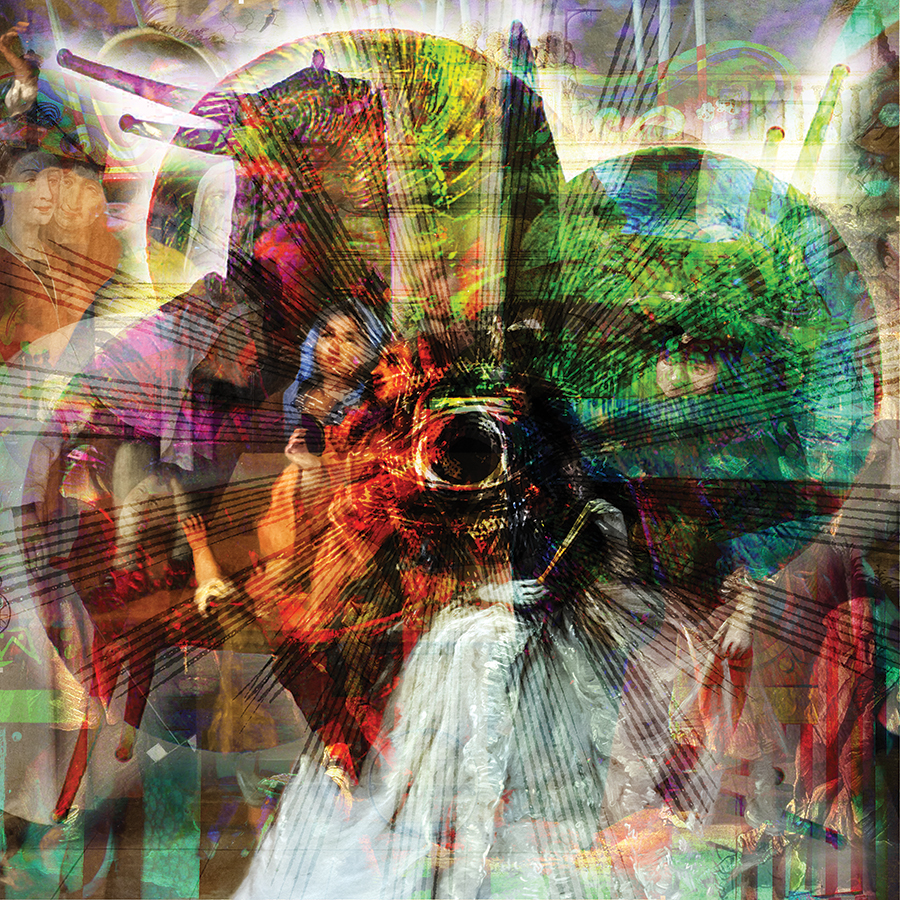
BARDS: Of The Shimmering Seraphs
Of The Shimmering Seraphs concerns itself with the interior landscape of the human spirit. Its twelve songs correspond to the opening sequence of the Nazilic Arcana, an initiatory collection of archetypes preserved throughout the Bell Archive.
Buy on BandcampMarginalia
Annotation 03-07B: Concerning the Baby-Mind King
The puppet play's account of a ruler driven into childish tyranny appears to derive from a collection of fragmentary oral traditions recorded during the Bell expeditions. These stories describe a local monarch who became increasingly dependent upon concentrated preparations of the gastropod secretion and eventually entered a state characterized by profound emotional volatility, impulsivity, and diminished judgment.
Nazilic commentators generally regard the Baby-Mind King as a cautionary figure rather than a villain. Unlike later moralistic retellings, the original stories do not portray him as wicked but as someone unable to reconcile authority with radical psychological openness. The resulting collapse of his rule is frequently cited in Cloak literature as evidence that regression alone is insufficient. The mind may be softened, but wisdom must still be cultivated.
For this reason the Baby-Mind King is often contrasted with the archetype of the Forest Witch. Both figures possess unusual permeability to experience, but only one remains rooted.
Annotation 03-07C: On Slug Milk and the Dissolution of Calcification
The substance sold by the Mountebank is identified as a preparation commonly referred to as Slug Milk. References consistently describe the use of carefully tuned acoustic vibrations to induce secretion of the milky liquid. Different frequencies are believed to produce distinct effects, with the most frequently cited preparation occurring near 580 hertz.
Nazilic literature repeatedly characterizes the resulting state as producing "desirable gullibility," a phrase that has generated considerable controversy among modern researchers. Contemporary readers often misunderstand this expression as an endorsement of credulity. However, within Nazilic philosophy, the term appears to refer instead to a temporary suspension of defensive certainty.
The Cloak regards cynicism as a form of psychological calcification. A hardening of perception which prevented the recognition of novel possibilities. Slug Milk is therefore valued not because it imposed beliefs but because it loosened them. One commentary compares the process to turning over compacted soil before planting. The objective was not to determine what would grow, but to restore the possibility of growth.
Annotation 03-07D: The Mountebank's True Commodity
The widespread assumption that the Mountebank profits from the sale of a medicinal substance has increasingly fallen out of favor among scholars. While the slug milk itself is unquestionably important, many contemporary commentators argue that the potion and the puppet show function as complementary components of a single operation.
The audience first encounters a story concerning exploration, transformation, and discovery. Only afterward are they offered the means by which they might experience the world differently themselves. Several researchers have therefore suggested that the Mountebank's actual trade is neither medicine nor entertainment, but receptivity.
One influential interpretation describes the archetype as a gardener of minds. The puppet show loosens the soil. The slug milk softens it further. What eventually grows afterward remains beyond the Mountebank's control.
Annotation 03-07E: On the Congregation's Secret
The final sequence has traditionally been interpreted as one of the most significant passages in the entire Mountebank cycle.
The congregation publicly condemns the Mountebank while privately purchasing his wares. Each individual believes themselves uniquely compromised, unaware that nearly everyone present has made the same choice. Scholars frequently identify this as an example of what later Cloak writings call the Hidden Consensus: a condition in which large numbers of people quietly participate in forbidden behaviors while maintaining outward conformity to social expectations.
Some commentators have suggested that the villagers are not purchasing slug milk despite the sermon, but because of it. The increasingly theatrical denunciations provide a form of social cover. By collectively condemning the Mountebank in public, each individual gains permission to continue seeking him in private.
The resulting dynamic has led certain historians to characterize the entire town as participating in a communal puppet show whose performers remain unaware they are on stage.