Production Notes
Drums, piano, vibes: R Thomas
Guitars, Bass, Vocals, PS Perkins
Recorded, mixed and mastered by Mystic Tape Deck ©2026
Lyric Sheet
In the ways of the world from the crib to the grave
Everybody’s a slave
Ain't nobody gonna save us
Save your bellyachin for another day
Baby they got ways
Of making you behave
When you hear those bells ringing in your brain
Before they drive ya insane
Get on a boat or a plane
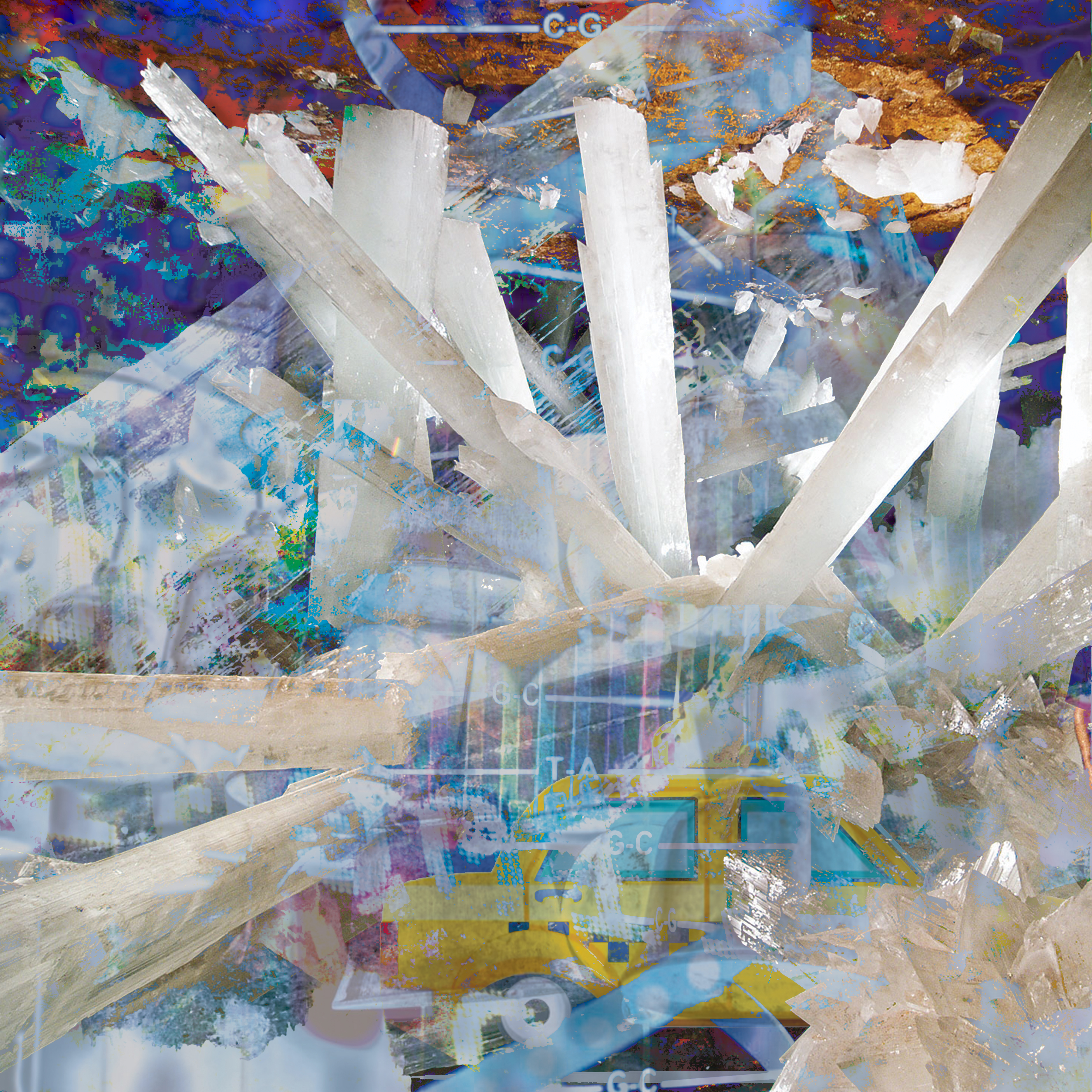
Take the golden taxi to the crystal caves
It’s a little like doomsday
You’re gonna have to be brave
Come join your friends in the crystal caves
Meet the underground conclave
At the standing wave
Gonna put the computer right into your vein
Connect the aqueous membrane
To the mineral mainframe
Gonna jump and jive when they play that jazz
Sprinkle on the pizazz
And just a little bit of zip zap biddly bap foo bar baz
Come and disappear in the crystal cave
Everybody’s a slave
Ain't nobody gonna save us
Now that you’ve arrived, won't you come on in?
We’re all about to begin
To start shedding our skin
Make like a snake, and gobble up that tail
It’s a hwale of a fairy tale
On the shell of a snail
In the mystery maze deep under the ground
A little magic we found
A way a watch can be unwound
To begin again inside the cave alone
A place we’re gonna call home
Amidst the shimmering stone
In the ways of the world from the crib to the grave
Everybody’s a slave
Ain't nobody gonna save us
Addendums
The Crystal Caves — The Mnemosyne
The Crystal Caves represent memory without a keeper. They are not a library in the ordinary sense, nor a tomb, nor a machine for preserving the past. They are what remains when the people who made the memory are gone, and the memory itself refuses to disappear.
As a Nazilic Arcana, The Crystal Caves symbolize inheritance, remembrance, and knowledge awaiting recognition. The descent into the caves is therefore not a journey backward into history, but a meeting with something that has been waiting beneath history for the right mind to arrive. The crystals do not reveal their secrets. They endure until someone becomes capable of remembering with them.
The Arcana carries a particular Nazilic paradox: memory does not belong to the one who remembers. It belongs to the thing that survived long enough to be remembered.
Upright: Memory. Inheritance. Preservation. Ancient knowledge awaiting rediscovery. The survival of an idea beyond its civilization.
Reversed: Forgotten inheritance. Lost knowledge. The inability to recognize what has been preserved. A civilization that remembers everything except what matters.
The question of the Arcana:
What has been waiting for you to remember it?
Among the Amaranthine Arcana, few objects have undergone a more dramatic reinterpretation than the Crystal Caves. Early Bell inventories describe the quartz shafts almost exclusively as anomalous geological specimens whose internal structures resisted contemporary explanation. Later accounts, influenced by surviving Cloak manuscripts, began associating the crystals with the legendary repository said to have been constructed beneath the Ecuadorian jungle during the closing years of the previous Returning. Modern scholarship has largely abandoned the question of whether the repository itself existed, concerning itself instead with the more curious possibility that the crystals had always intended to survive long enough to become part of the future.
This distinction has proven foundational to subsequent Nazilic thought. Throughout later Bell literature, the Mnemos Quartz is seldom discussed as a storage device in the ordinary sense. Rather, it is regarded as a vessel through which memory patiently outlives the civilizations that first gave it form. The crystal simply endures until another generation becomes capable of remembering with it.
For readers of the Arcana, the card has gradually come to symbolize a different kind of inheritance. Knowledge is not portrayed as something discovered, nor even transmitted, but as something awaiting recognition across immense intervals of history. The descent into the Crystal Caves therefore represents an encounter with the quiet labor of forgotten ancestors, whose final act was to leave behind a fragment sturdy enough to survive its passing.
As recorded in the Sixth Bell Concordance:
"The crystal remembers nothing, it merely refuses to forget."
Marginalia
Annotation 04-13A: The Mnemos Hypothesis
The Crystal Caves occupy a singular position within Bell scholarship, being among the few Nazilic artifacts whose significance derives less from their alleged powers than from the civilization said to have produced them. Early commentators described the crystals as repositories of memory, though later Bell historians increasingly rejected the notion that they functioned as simple archives. Rather, the prevailing interpretation identifies them as attempts to preserve continuity across the Great Returnings themselves. If the Bell family accounts are accepted, the crystals were never intended to remember a world that had passed. They were constructed for a world that had not yet forgotten.
This distinction has become foundational to modern Nazilic thought. Memory, within the Cloak tradition, is rarely understood as recollection of the past. More often it denotes an inheritance awaiting recognition. One does not recover forgotten knowledge so much as encounter truths carefully prepared by unknown ancestors whose greatest achievement was ensuring that remembrance itself could survive the collapse of history.
Annotation 04-13B: The Doctrine of the Last Stone
The recurring image of crystalline preservation is generally regarded as the earliest surviving expression of what later Bell philosophers termed the Doctrine of the Last Stone: the conviction that hope acquires its greatest significance only after every ordinary strategy has failed. The unnamed architects of the Ecuadorian repository are never portrayed as believing they could prevent the world's destruction. Their labor begins only after accepting that destruction had become inevitable.
For this reason, later Nazilic literature consistently treats the crystal not as a monument to technological achievement, but as an act of extraordinary humility. Its builders relinquished any expectation of witnessing the future they sought to preserve. Their task was simply to become worthy ancestors of people they would never meet.
As Adelaide Mercer later observed:
"A library is not built for its librarians. It is built for those who arrive after the fire."
Annotation 04-13C: The Bell Ringing Phenomenon
Several Bell manuscripts describe a distant ringing before encounters with the Mnemos Quartz. The sound is not heard by everyone. Only certain individuals report it. The accounts remain remarkably consistent.
Early investigators searched for an acoustic explanation. Bell commentators eventually turned elsewhere. Most now associate the ringing with inherited memory becoming recognizable. The sound marks a change in the listener. The crystal merely accompanies it.
Virginia Bellwether cautioned against mystical interpretations. She rejected both prophecy and hallucination. In one surviving letter she described the experience as:
"The discomfort of remembering what no personal memory could contain."